
Perimenopause, Menopause & Your Gut: What the Research Shows
Perimenopause is not a hormone problem that happens to your gut — it's a gut transition that reshapes how your hormones behave. The dramatic, unpredictable symptoms that define the perimenopausal window — hot flashes that arrive without warning, sleep that breaks at 3am, mood shifts that feel foreign, weight that redistributes without explanation, and brain fog that clouds what used to be clear — are not simply the result of declining estrogen. They are amplified, prolonged, and in many cases caused by what happens to that estrogen in the gut. The estrobolome — the community of gut bacteria responsible for metabolizing and recirculating estrogen — changes significantly as ovarian function shifts, and when it isn't supported, the hormonal turbulence of perimenopause becomes harder to navigate. Research is increasingly pointing to gut microbiome health as one of the most consequential and most overlooked levers in midlife women's wellness. Daily Nouri was built around this science — with targeted products designed for women at every stage of the hormonal transition.
Menopause Health
Targeted gut support for the menopause transition
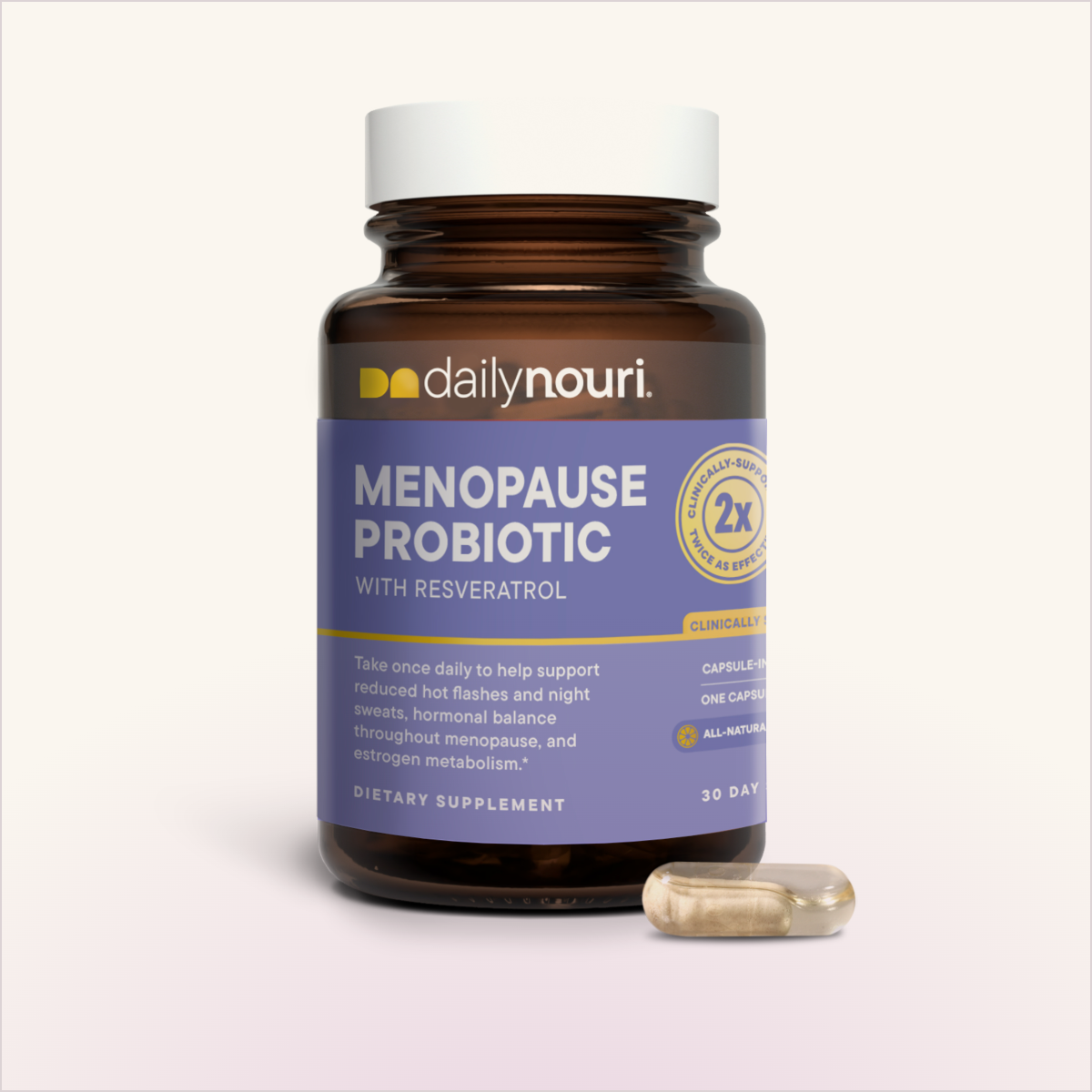
Daily Nouri offers gut-hormone support formulated specifically for midlife women. Our Menopause Health probiotic is designed for women in perimenopause and beyond. For women in earlier perimenopausal stages still experiencing cyclical symptoms, Hormone Balance supports estrogen metabolism through the full transition. Not sure which is right for you? Find your probiotic.
01 — The Big Picture
Why Menopause Is a Gut Transition, Not Just a Hormone Transition
The conventional framing of menopause is simple: the ovaries produce less estrogen, and the body adjusts. But that framing misses the degree to which the gut is involved in both the hormonal transition itself and the severity of its symptoms.
Here is what the research increasingly shows: the gut microbiome changes substantially in perimenopause and menopause — in composition, diversity, and function. These changes aren't just a side effect of hormonal decline; they are part of the mechanism by which hormonal decline becomes symptomatic. And they create a feedback loop: declining estrogen alters the gut microbiome, and an altered gut microbiome changes how the remaining estrogen is handled — which amplifies or prolongs symptoms.
The chicken-and-egg of hormones and the gut
Estrogen and the gut microbiome are in constant bidirectional communication. Estrogen influences the gut: it affects gut motility, barrier integrity, microbiome composition, and the activity of the immune cells lining the gut wall. The gut influences estrogen: through the estrobolome, it determines how much estrogen stays in circulation versus how much is cleared.
When estrogen declines in perimenopause, it takes some of its gut-protective effects with it. The gut microbiome becomes less diverse. The gut barrier becomes more permeable. The estrobolome's ability to regulate the remaining, smaller pool of estrogen becomes less efficient. The result is a system under double pressure: less estrogen coming in from the ovaries, and a gut that's less able to handle it effectively.
This is why two women with identical hormone levels in perimenopause can have radically different symptom experiences. The gut is the variable. And unlike ovarian function — which cannot be meaningfully reversed — gut microbiome health is remarkably responsive to consistent, targeted support.
02 — The Mechanism
How the Estrobolome Changes in Perimenopause
The Estrobolome
The collection of gut bacteria that metabolize estrogen — effectively acting as an estrogen control valve throughout the monthly cycle.
In the years before menopause, these bacteria are constantly at work: regulating how much estrogen recirculates versus how much exits via the stool. As perimenopause begins — typically in the late 30s or 40s, sometimes even earlier — several things happen simultaneously:
Estrogen levels become erratic.
Rather than declining in a straight line, estrogen in perimenopause surges, spikes, and crashes — sometimes dramatically. The estrobolome, built to handle a predictable monthly rhythm, struggles to keep up with these swings.
Gut microbiome diversity decreases.
Research published in mSystems demonstrated that postmenopausal women have significantly reduced gut microbiome diversity compared to premenopausal women. This loss of diversity includes the estrobolome bacteria responsible for efficient estrogen metabolism.
Beta-glucuronidase activity becomes dysregulated.
The enzyme that determines whether estrogen recirculates (beta-glucuronidase) may become either over- or under-active as microbial communities shift. This produces erratic estrogen recirculation — some periods of estrogen dominance, some periods of rapid clearance — which maps directly onto the unpredictability of perimenopausal symptoms.
The gut barrier becomes more permeable.
Estrogen helps maintain tight junction proteins in the gut wall. As estrogen declines, gut permeability often increases — contributing to systemic inflammation, immune activation, and a worsening of the inflammatory component of menopause symptoms.
Supporting the estrobolome during this transition doesn't reverse the natural hormonal change — but it meaningfully improves the gut's ability to manage the estrogen that remains, reducing symptom volatility and supporting the full system.
03 — The Symptom Map
The Gut-Symptom Map: Which Perimenopausal Symptoms Connect to the Microbiome
| Symptom | Gut-Hormone Mechanism |
|---|---|
| Hot flashes and night sweats | Rapid estrogen fluctuations + gut-mediated serotonin/temperature regulation |
| Sleep disruption | Gut-brain axis serotonin; body temperature regulation; progesterone and GABA gut connection |
| Mood changes, anxiety, low mood | Gut serotonin (90% produced in the gut); estrobolome-driven estrogen swings; gut-brain axis disruption |
| Brain fog and poor concentration | Neuroinflammation from gut permeability; reduced estrogen's neuroprotective effects amplified by dysbiosis |
| Weight gain, especially abdominal | Gut microbiome composition linked to metabolic function; estrogen decline shifts fat distribution |
| Bloating and GI changes | Gut motility changes with estrogen decline; microbiome composition shifts |
| Joint pain and inflammation | Systemic inflammation from gut dysbiosis and increased gut permeability |
| Vaginal dryness and urinary issues | Urogenital microbiome connected to gut microbiome; estrogen decline affects both |
| Bone density loss | Gut microbiome directly influences bone metabolism via SCFAs and immune regulation |
| Skin changes | Gut-skin axis; reduced estrogen + gut inflammation affects collagen, sebum, skin barrier |
The breadth of this list is significant: it reflects the degree to which the gut is a central hub in the menopause transition, not a peripheral player. Addressing gut health is not a complementary strategy — it is a foundational one.
04 — Vasomotor Symptoms
Hot Flashes, Night Sweats, and the Gut Connection
Hot flashes are the most common perimenopausal symptom — experienced by up to 75% of women in the US during the transition. They are conventionally explained as a thermoregulatory response to estrogen withdrawal in the hypothalamus. That explanation is accurate as far as it goes. But the gut provides a critical amplifying or dampening variable.
of women in the US experience hot flashes during the menopause transition — and gut microbiome diversity is one of the variables that moderates their severity.
Serotonin and temperature regulation
The gut produces approximately 90% of the body's serotonin. Serotonin is not only a mood neurotransmitter — it also plays a direct role in thermoregulation. Serotonin signaling in the hypothalamus influences the body's temperature set point, and disruptions in gut-produced serotonin can make the thermoregulatory instability of menopause more severe.
When gut dysbiosis reduces serotonin production and signaling, the hypothalamic response to estrogen fluctuation becomes more pronounced. Hot flashes get more intense and more frequent. Night sweats become more disruptive.
The equity gap in symptom severity
Research suggests that women with greater gut microbiome diversity experience fewer and less severe vasomotor symptoms (hot flashes, night sweats). A 2021 study in Menopause found that gut microbiome composition was associated with vasomotor symptom severity in midlife women. Women with greater Lactobacillus diversity had a more favorable symptom profile — consistent with the hypothesis that estrobolome diversity moderates the estrogen-signaling disruption underlying hot flashes.
This doesn't mean probiotics eliminate hot flashes. It means that optimizing gut health — including the estrobolome — is one of the most accessible levers for reducing their frequency and intensity.
05 — The Gut-Brain Axis
Brain Fog, Mood, and the Gut-Brain-Hormone Axis in Midlife
Brain fog is one of the most surprising and distressing perimenopausal symptoms — the sense that thinking has become slower, less sharp, or less reliable. It is often dismissed or misattributed to stress or aging. But it has a biological basis that runs directly through the gut.
Neuroinflammation and gut permeability
As the gut barrier becomes more permeable in perimenopause, bacterial fragments called lipopolysaccharides (LPS) can enter the bloodstream and trigger a low-grade inflammatory response. Neuroinflammation — inflammation that reaches the brain — is a well-documented driver of cognitive symptoms including brain fog, difficulty concentrating, and memory disruption.
Estrogen and neuroprotection
Estrogen is neuroprotective. It supports synaptic plasticity, reduces neuroinflammation, and maintains blood-brain barrier integrity. As estrogen declines in perimenopause, these protective effects diminish. When a compromised gut adds neuroinflammation on top of reduced estrogenic neuroprotection, the cognitive impact is compounded.
Mood, anxiety, and gut serotonin
The mood changes of perimenopause — anxiety that appears from nowhere, low mood, emotional volatility — are not simply "hormonal." They involve real changes in neurotransmitter signaling. The gut produces the majority of the body's serotonin, and gut dysbiosis reduces serotonin availability. As estrogen declines (estrogen directly upregulates serotonin receptors), and as gut dysbiosis simultaneously reduces serotonin production, the combination creates a neurochemical environment susceptible to mood symptoms.
Targeted gut support that rebuilds microbiome diversity and reduces gut inflammation is a meaningful intervention for both brain fog and mood changes in perimenopause.
06 — Bone & Metabolic Health
Bone Density, Metabolic Health, and the Gut Microbiome
The gut-bone connection
Bone loss accelerates significantly in perimenopause and menopause. The conventional explanation is estrogen's role in suppressing osteoclast activity — the cells that break down bone. But research has identified a second mechanism: the gut microbiome directly influences bone metabolism.
Gut bacteria produce short-chain fatty acids (SCFAs), which regulate immune activity in the bone marrow and reduce the inflammatory signals that accelerate bone resorption. A diverse, fiber-fed gut microbiome produces more SCFAs and provides a partial protective effect on bone that is independent of — and complementary to — estrogen's role.
Additionally, gut health is central to calcium and vitamin D absorption. A compromised gut reduces the efficiency of these bone-critical nutrients regardless of dietary intake.
Metabolic changes and the microbiome
Weight redistribution in menopause — particularly the shift toward abdominal fat — is partly mediated by gut microbiome composition. Research has identified distinct microbiome profiles in women who experience more versus less metabolic disruption in menopause. Gut bacteria influence insulin sensitivity, fat storage signaling, and energy metabolism in ways that are emerging as significant targets in midlife metabolic health.
07 — PMOS
PMOS (Formerly PCOS) and Its Midlife Implications
The global renaming of PCOS to PMOS (Polycystic Metabolic and Ovarian Syndrome) by the Endocrine Society reflects a broader reconceptualization: what was considered an ovarian condition is now understood as a systemic endocrine and metabolic syndrome affecting approximately 1 in 8 women worldwide — over 170 million women globally.
women worldwide are affected by PMOS — over 170 million — and the gut-hormone axis is central to both PMOS and the perimenopause transition.
For women with PMOS, perimenopause represents a complex intersection. The metabolic and hormonal disruptions that characterize PMOS — insulin resistance, androgen excess, irregular cycles, inflammation — converge with the hormonal shifts of perimenopause in ways that can amplify both.
The gut-hormone axis is central to both PMOS and perimenopause. The estrobolome influences estrogen levels in PMOS (often characterized by estrogen excess and recycling), and gut dysbiosis is increasingly recognized as a driver of PMOS-related insulin resistance and inflammation.
Women navigating both PMOS and perimenopause may benefit particularly from consistent estrobolome support — addressing the gut-hormone dysfunction that underlies both conditions simultaneously.
08 — The Protocol
How to Support Your Estrobolome in Perimenopause and Beyond
Targeted probiotic support for the transition
Daily Nouri offers two products designed for women in this phase:
- Daily Nouri Menopause Health — formulated specifically for women in perimenopause and menopause, targeting the gut-hormone axis as estrogen transitions
- Daily Nouri Hormone Balance — for women in earlier perimenopause still experiencing cyclical symptoms, with seven clinically-studied strains (12 billion CFU) and Ahiflower® Omega 3, 6, 9 targeting estrogen metabolism and the estrobolome
The key is consistency. Probiotic colonization is dose-dependent and time-dependent; the microbiome responds to daily, sustained support. Most women notice meaningful changes in symptom frequency and intensity within 60–90 days.
Maximize dietary fiber (especially prebiotic fiber)
Fiber feeds the gut bacteria that support estrogen clearance, produce bone-protective SCFAs, and maintain the gut barrier. Aim for 30+ grams daily from vegetables, legumes, ground flaxseed, chia, oats, and berries. Prebiotic fiber specifically — from asparagus, garlic, onions, leeks, bananas, and Jerusalem artichokes — preferentially feeds the Lactobacillus and Bifidobacterium strains that support the estrobolome.
Prioritize protein
Protein requirements increase in perimenopause and menopause to maintain muscle mass and support metabolic health. Adequate protein also supports gut barrier integrity (amino acids are the building blocks of tight junction proteins). Aim for 1.2–1.6g of protein per kg of body weight — higher than general population recommendations, especially if you are active.
Eat cruciferous vegetables and DIM-rich foods daily
Broccoli, cauliflower, kale, Brussels sprouts, and cabbage contain DIM and sulforaphane — compounds that directly support estrogen metabolism in both the liver and the gut. These foods are particularly valuable in perimenopause when the estrobolome is under strain and every lever of estrogen clearance matters.
Support bone health through the gut
Beyond calcium and vitamin D, support gut-mediated bone health by feeding the bacteria that produce SCFAs. Fermented foods (kefir, yogurt, kimchi, sauerkraut), prebiotic fiber, and targeted probiotic supplementation all contribute. Vitamin K2 — found in fermented foods like natto and some cheeses — works synergistically with vitamin D to support bone matrix formation.
Manage stress and prioritize sleep
Cortisol is profoundly disruptive to the gut microbiome and accelerates the estrobolome changes of perimenopause. Chronic stress in the perimenopausal years worsens hot flashes, sleep disruption, mood symptoms, and gut health simultaneously. Sleep is the period during which the gut microbiome undergoes its daily restoration cycle; consistent, quality sleep is non-negotiable for microbiome health.
Reduce alcohol and ultra-processed food
Alcohol worsens hot flashes, disrupts sleep, impairs estrogen clearance through the gut and liver, and accelerates gut microbiome decline. Even moderate alcohol intake has been shown to worsen perimenopausal symptoms in multiple studies. Similarly, ultra-processed food drives the gut dysbiosis that amplifies the gut-mediated component of every perimenopausal symptom.
09 — Questions
Frequently Asked Questions
When does perimenopause start, and how do I know if that's what I'm experiencing?
Perimenopause typically begins in the mid-to-late 40s, though it can start as early as the late 30s. Early signs include changes in cycle length or flow, new or worsening PMS, sleep disruption, mood changes, and occasional hot flashes. Because these symptoms overlap with many other conditions, a hormone panel (including FSH, estradiol, and progesterone) can provide useful information. Perimenopause is officially defined as the transition period ending 12 months after the last menstrual period.
Can gut health support actually reduce hot flashes?
Research suggests gut microbiome diversity is associated with vasomotor symptom severity. Supporting the estrobolome doesn't eliminate the underlying hormonal change driving hot flashes, but it can reduce the amplitude and frequency by moderating estrogen fluctuation and supporting gut serotonin production. Most women who report improvement in hot flashes from gut-targeted interventions see gradual reduction over 60–90 days of consistent support.
How is Daily Nouri Menopause Health different from Hormone Balance?
Both products target the gut-hormone axis. Daily Nouri Menopause Health is specifically formulated for the hormonal environment of perimenopause and beyond, when estrogen is declining and the gut microbiome is shifting in ways specific to this life stage. Hormone Balance is primarily designed for women in cycling years, though it benefits women in early perimenopause who are still experiencing cyclical symptoms. If you're unsure, our Find Your Probiotic quiz will point you to the right one.
Does gut health affect vaginal dryness?
Yes — through two mechanisms. First, the urogenital microbiome (vaginal and urinary) is directly connected to the gut microbiome; Lactobacillus species that dominate the vaginal environment are influenced by the gut's bacterial communities. Second, estrogen influences vaginal tissue directly, and when estrobolome dysfunction reduces the effective estrogen available, vaginal tissues thin more rapidly. For vaginal microbiome support specifically, see Daily Nouri Vaginal Balance.
I'm on HRT. Should I still support my estrobolome?
Yes. HRT addresses the declining supply of estrogen but not the gut's ability to metabolize it. If the estrobolome is dysfunctional, some of the estrogen from HRT may be poorly cleared, affecting both its effectiveness and the side effect profile. Supporting the estrobolome alongside HRT helps ensure that estrogen — whether endogenous or supplemental — is being metabolized efficiently.
Will Daily Nouri products interact with HRT or other medications?
Daily Nouri products are probiotics and omega supplements. They do not contain hormones and are generally well-tolerated alongside HRT. As with any supplement, consult your healthcare provider before starting if you are on prescription medications or managing a medical condition.
What about the gut connection to bone health in menopause?
Research has identified a meaningful gut microbiome-bone health connection. Gut bacteria produce short-chain fatty acids that regulate bone metabolism, and gut health affects the absorption of bone-critical nutrients (calcium, vitamin D, vitamin K2). Supporting gut microbiome diversity through targeted probiotics and prebiotic-rich food is a complementary strategy to conventional bone health support in menopause.
How long should I take Daily Nouri during perimenopause?
Perimenopause can span 4–12 years; menopause and post-menopause are lifelong stages. The gut-hormone axis doesn't resolve after menopause — if anything, it becomes more important as the body's main tool for estrogen management. Daily Nouri products are designed for indefinite daily use.
10 — References
References
- Kwa M, Plottel CS, Blaser MJ, Adams S. The Intestinal Microbiome and Estrogen Receptor-Positive Female Breast Cancer. Journal of the National Cancer Institute. 2016;108(8).
- Peters BA, Lin J, Qi Q, et al. Menopause Is Associated With an Altered Gut Microbiome and Estrobolome, With Implications for Adverse Cardiometabolic Risk in the Hispanic Community Health Study/Study of Latinos. mSystems. 2022;7(3):e0027322.
- Vieira AT, Castelo PM, Ribeiro DA, Ferreira CM. Influence of Oral and Gut Microbiota in the Health of Menopausal Women. Frontiers in Microbiology. 2017;8:1884.
- Deecher DC, Dorries K. Understanding the pathophysiology of vasomotor symptoms (hot flushes and night sweats) that occur in perimenopause, menopause, and postmenopause life stages. Archives of Women's Mental Health. 2007;10(6):247-257.
- Rance NE, Krajewski SJ, Smith MA, et al. Neurokinin B and the hypothalamic regulation of menopause. Brain Research. 2010;1364:116-128.
- Yoon K, Kim N. Roles of Sex Hormones and Gender in the Gut Microbiota. Journal of Neurogastroenterology and Motility. 2021;27(3):314-325.
- Ohlsson C, Sjögren K. Effects of the gut microbiota on bone mass. Trends in Endocrinology & Metabolism. 2015;26(2):69-74.
- Lindheim L, Bashir M, Münzker J, et al. Alterations in Gut Microbiome Composition and Barrier Function Are Associated with Reproductive and Metabolic Defects in Women with Polycystic Ovary Syndrome (PCOS). PLoS One. 2017;12(1):e0168390.
This article is for educational purposes and is not medical advice. It is not intended to diagnose, treat, cure, or prevent any disease. Statements about Daily Nouri products have not been evaluated by the FDA. Always consult a qualified healthcare provider before starting a new supplement, especially if you are pregnant, breastfeeding, on medication, or managing a medical condition.
Gut support built for the transition
Your estrobolome is one of your most powerful tools for navigating perimenopause
The gut-hormone axis doesn't resolve after menopause — it becomes the body's main tool for estrogen management. Start supporting it today.